
Ad platforms typically optimize toward a conversion objective. Usually, this is a form completion, a phone call (over a set length), or a sale. Except for a sale, the first two are often more affordable to produce.
So, when sales says the leads are bad, two things need to be revisited: 1. which key event are you focused on; and 2. what happens to the lead after they click?
Where does the lead quality gap start?
Hint: It's not always at the click or the bidding strategy. Invoca's 2026 lead conversion benchmarks cover more than 70 million calls across 10 industries. Overall, 42% of phone leads convert on the call, but the share of answered calls that count as leads runs from 29%-53% depending on the industry.
For instance, in telecom, 51% of callers reach a person but 47% of providers never ask them to buy or sign up for services. In financial services, 57% reach a person but 65% of these companies don't ask the lead to move forward. That's almost hard to believe, right? That's Sales 101! So, some of the gap sits with the sales team, and no bid strategy fixes that.
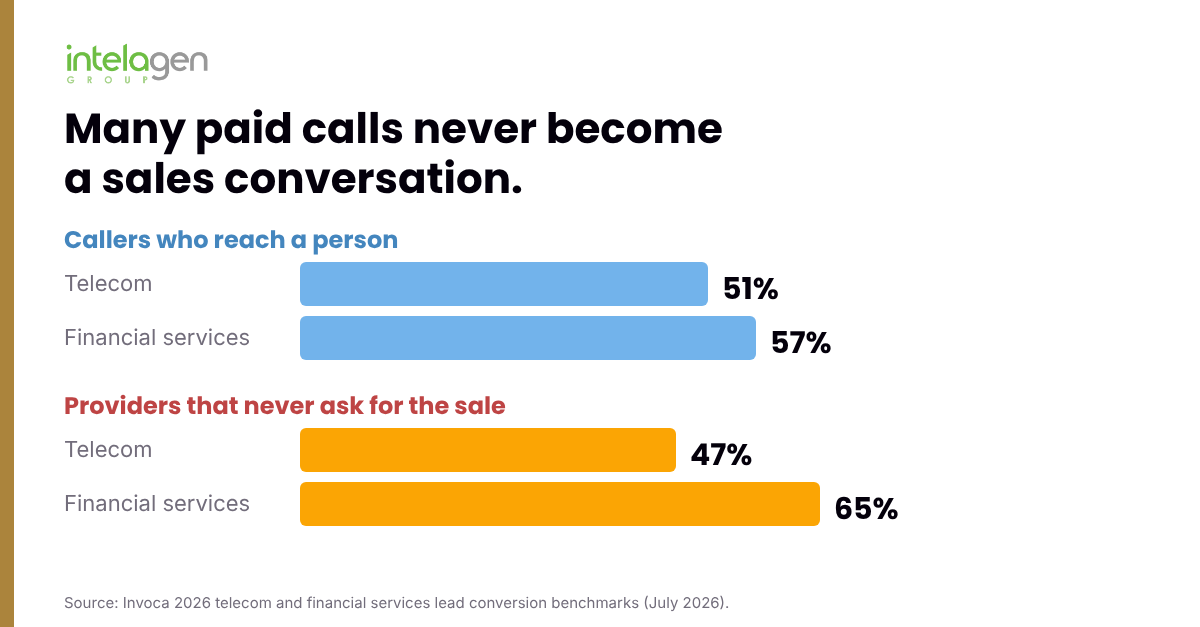
Google sees it differently. Its lead generation guide from Marketing Live, as PPC Land summarizes it, argues that most lead quality problems typically come from measurement, quality and design, not from sales. That is a platform vendor's view, and Invoca's numbers say sales handling matters too. We tend to think both are correct. But, the measurement and design side is the part you can address from your marketing efforts.
Which stage should you send back to the platform?
Google Ads now has two goal types for offline leads. A qualified lead is one your team vetted in your CRM. A converted lead is one that reached a step you define, usually a sale. Imports from Salesforce and other CRMs default to converted lead, so if nobody chooses, your account is learning from the deepest and rarest event you have.
We optimize for the closest metric we can get to revenue. Each step down the funnel gets closer to revenue and further from the click. For most B2B and B2C lead generation accounts the stages look something like this:
- Form completion or call. Plenty of volume and fast feedback, and it rewards whatever is cheapest to produce.
- Qualified Leads. Sales accepted the lead. It clears out spam and tire kickers within days, but it still counts leads that fail a check, an eligibility screen or a fit review.
- Converted Customer. A customer converted, a contract signed, an order placed, or an application completed. This stage directly ties to revenue but may have fewer events and a longer lag time.
- Retained Customer. Still a customer after the first billing cycle or the first term. This is a retention play. It's often the truest signal and the thinnest one, because cancellations and no-shows have already been removed.
So, what does this mean for marketing?
- Pick one stage to steer the bids. Import both a qualified and a won stage into Google Ads. Mark the deepest one that still produces a steady monthly volume as primary, because that is the event the bidder optimizes toward. Mark the other as secondary. Google counts secondary actions in reporting only, so you can still see them without them steering bids. If the deeper stage is too sparse for the bidder to learn from, step back one stage.
- Fix the call step first. Pull your answer rate by campaign. If it looks like the 51% and 57% above, roughly half of your paid calls never reach a person, and the platform is optimizing toward noise.
- Report by lead date. Group sales back to the date the lead was created, not the date the sale closed. Then give each group the same time to mature before you compare them. Otherwise, this month's spend gets compared with sales that have not closed yet, and the deeper stage looks worse than it is.
- Compare 'like' periods. Review results month over month, quarter over quarter and year over year. Keep your stage definitions the same across the periods you compare. If you redefine what counts as qualified, note the date and restate the earlier periods, or the comparison stops meaning anything.
Bottom line: Optimize for the stage closest to revenue that still gives the platform steady volume. We can review your current ad campaigns and your digital strategy to see which conversions they are optimizing for and where the call and CRM steps leak. Email us to get started.