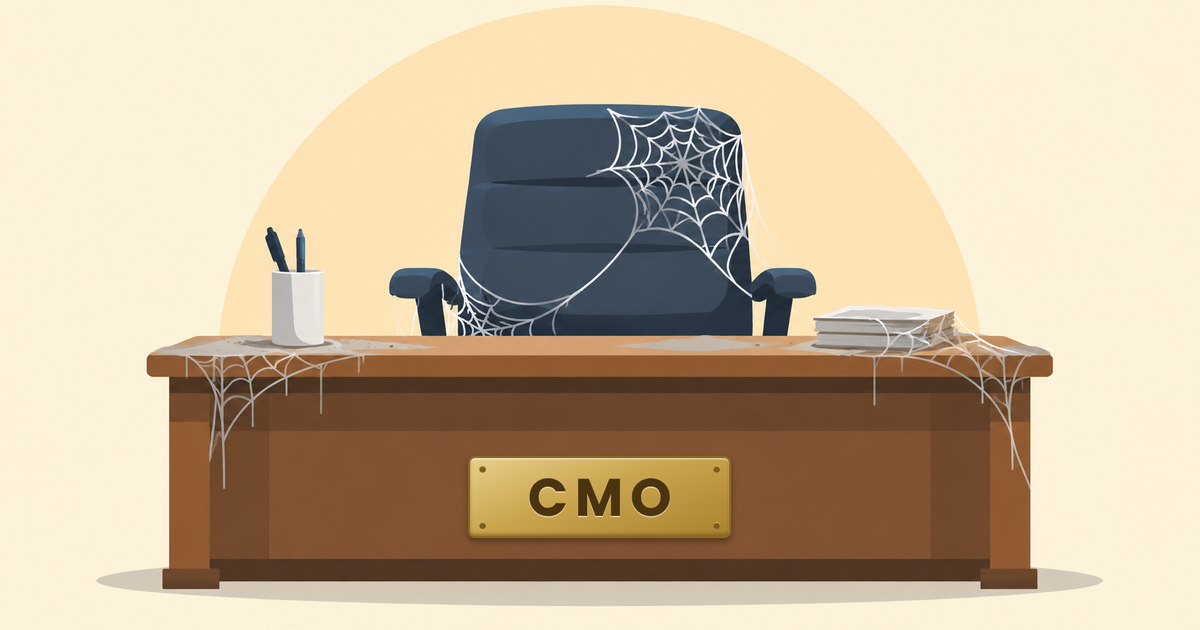
An executive search firm's January 2026 review of S&P 500 companies found that roughly one in three had no enterprise-level CMO. These companies didn't stop marketing. The title went away and the work moved to others. So, who is accountable?
What changed in the job?
The seat is being rebuilt around revenue and results. Marketing Dive reports more companies creating combined roles (like chief commercial officer) that add sales and customer responsibilities to marketing. Where the CMO title remains, the person holding it doesn't stay long. Average tenure at those companies is 4.1 years, and a study cited by Marketing Dive found 30% of CMOs have held the role for under 18 months. Why? Is it that these roles are ineffective? Or is the bar set too high?
What are you measured on now?
The bar is revenue-based results. One Forbes Communications Council contributor argues that marketing leaders should understand acquisition cost, conversion bottlenecks and diminishing returns, not only pipeline or lead volume. The same piece says predictability is won or lost in the handoffs between marketing, sales and customer success. For direct marketing, that starts with one shared definition of a lead. If marketing counts a form submission and sales counts a qualified conversation, your CPL and your CRM will never agree.
Where does that leave marketing? Marketing rarely owns the close, so the closest metric to revenue it can defend is cost per lead. Count leads by lead date and compare them month over month, quarter over quarter and year over year. Lead date ties spend to the leads it produced, not to whenever a deal happened to close. Whatever the timeframe, if your CPL doesn't tie to the leads in your CRM, you're defending a number nobody can verify.
Where do MarTech and AI fit?
They're separate problems with the same test.
of CMOs rate their organization's ability to adopt and innovate with new marketing technology as excellent
Source: Marketing Diveof CMOs hired this year have AI-related skills, against 9% of those in the role four years or more
Source: Marketing DiveMarTech first. Only 11% of CMOs rate their organization's ability to adopt and innovate with new marketing technology as excellent, per the Lippincott and Bloomberg Media CMO Outlook 2026 as cited by Marketing Dive. Most stacks grew one purchase at a time. Before each renewal, ask which report or decision breaks if you cancel the tool.
As for AI, the hiring data tells part of the story. Among CMOs hired this year, 26% have AI-related skills, against 9% of those who have been in the role four years or more. Spending tells the rest. Gartner's 2026 CMO spend survey found CMOs putting 15.3% of budgets toward AI, while only about 30% say their organization is ready to scale it. The Forbes contributor's warning is that AI speeds up a process that's already broken. So, every AI line should name the revenue metric it moves. If it can't, it's an experiment, not a budget line.
Who answers at your company?
- Who ties CPL to CRM leads? Someone should be able to reconcile last month's CPL to leads in the CRM by lead date.
- Who decides what a tool is worth? Someone should be able to name the report that breaks if a MarTech tool goes away.
- Who owns the revenue metric for each AI line? Every line needs a named person and a number.
If you can't name someone for each, the accountability has no owner.
Bottom line: The title may not exist at your company. The accountability still does. Email us and we'll review your current campaigns and your digital strategy, and help with the accountability concerns.